The first and the final place where people can encounter your business or place is commonly the parking lots. So little layout problems are fast becoming major safety problems at night due to poor visibility. Factor in the eroded lines, interfering walkways, and markings that are not clearly marked and you have a harder time getting around the crossing with the certainty of your drivers and pedestrians. That is where Reflective line Striping is to be considered among the best safety upgrades a property owner can do.
Herein we elaborate on how reflective markings operate, why they are more effective in the dark and how these promote the elimination of accidents and liability and confusion in the crowded parking lots directly.
The reasons why nighttime parking lots are more dangerous
There are a number of things that work together to cause unsafe conditions after sunsets:
- limited lighting coverage
- glare from headlights
- wet pavement after rain
- worn or faded markings
- unclear pedestrian zones
Pavement marks are vital because the drivers use it to determine the direction of the lanes, turning points, and stopping points. In the absence of adequate visibility, the circulation at the parking lot is erratic.
A Reflective Striping upgrade can assist the driver to identify information on the critical layout sooner and more effectively.
What is different about reflective line striping?
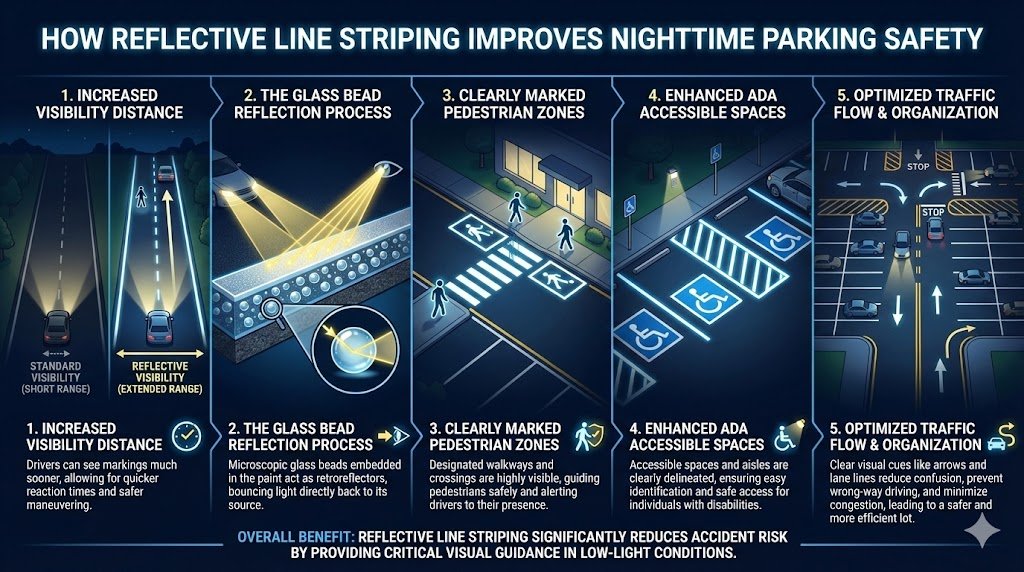
Reflective pavement markings are done using tiny glass beads that are integrated in the paint or thermoplastic. As headlights of the vehicle collide with these beads, the light is reflected back straight to the driver.
This creates:
- brighter line visibility
- longer detection distance
- clearer lane boundaries
- greater coerciveness when compared to dark pavement.
Normal paint might be good in the daytime, but reflective systems out do them on a grand scale in the dark.
Such difference in performance is what makes Reflective Striping a suggested design of high traffic commercial and residential property.
The effect of reflective line striping on increasing safety at night
Previous road sign identification
Draivers will be able to spot the parking spots, lanes and the turning points in a relatively earlier time. This minimizes the braking at the last moment, sharp turns, and vehicle collisions.
Reflection materials make the interpretation of the clear directional arrows and stop bars so much easier.
Safer pedestrian crossings
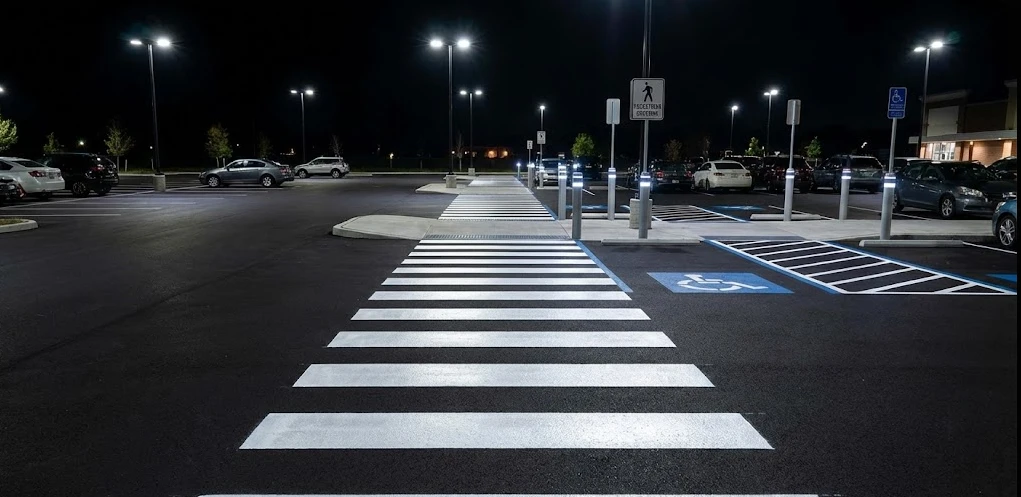
Crosswalks and walkway borders come out far more distinct with headlights. This gives more time to the drivers to react and more pedestrians can be seen in the darker parts of the lot.
Proper Reflective Stripping assists in the separation of both the foot traffic and the area of vehicle movement.
Better ADA accessibility
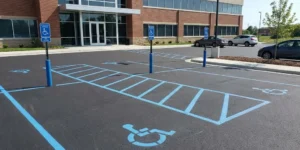
Parking space, loading area, and aisles used to access the premises should be kept in high visibility all the time. Reflective markings also ensure that clarity is preserved despite uneven or an obstructed overhead lighting.
This facilitates usability and compliance among individuals with mobility problems.
Better traffic system and arrangement.
In case drivers are able to identify the rows of stalls, fire lanes, and exits immediately traffic flows in a more efficient manner. Mistaken identity at cross roads and terminals is minimized.
This organized movement is a great advantage of well-thought Reflective Striping designs.
Less exposure to property liability.
It is also common to have cases of accidents in parking lots due to lack of clarity on the markings or lack thereof when it is dark. Reflective marks are used to show that the owner of the property had made reasonable efforts to ensure proper safety in navigation.
This is a proactive strategy that can be used to manage risk exposure in incident claims.
Where reflective line striping suits best
The maximum advantage of reflective materials is in:
- shopping centers with multi-tenants.
- medical offices and hospitals.
- apartment complexes
- schools and universities
- industrial parks and warehouses.
- entertaining places, stadiums.
Reflective Striping can be improved in any property that has evening traffic.
Comparison table – standard vs reflective striping
| Feature | Standard Paint | Reflective Striping |
| Night visibility | Low | High |
| Headlight reflection | None | Strong |
| Lane recognition distance | Short | Long |
| Pedestrian marking clarity | Limited | Excellent |
| Overall safety performance | Basic | Advanced |
The performance of reflective line striping in wet weather
Rain causes surface glare and lacks contrast between paint and asphalt. Still reflective glass beads reflect the light directly to the driver keeping the lines clear even when the pavement is wet.
Reflective materials are always more practical in real world scenarios in places where there is continual rainfall.
Servicing and life cycle benefits
Reflective systems might be a bit more expensive in the short run, but in the long run, they can be more beneficial.
Key advantages include:
- greater time of visualization prior to re-striping.
- better resistance to fading
- increased visibility with age of markings.
- easier safety inspections
This is why Reflective Striping would be an economical option when it comes to properties wishing to have fewer repainting cycles and more predictable outcomes in regards to the safety.
The compliance and site standard is facilitated by reflective line striping
The majority of the parking lot layouts should abide by:
- fire lane marking guidelines.
- ADA guidelines on accessibility.
- flow and directional norms of traffic.
- local stripping requirements by a municipality.
Reflective materials do not substitute good layout design -but they significantly enhance the performance of the layout designs at night.
Professional striping contractors consider:
- stall dimensions
- aisle widths
- crosswalk placement
- accessible route markings
prior to installing Reflective Striping in order to achieve the goals of safety as well as compliance.
Common mistakes to avoid
- applicability imbalanced mixing of reflective and non-reflective marks.
- omission of surface preparation.
- omission of reapplying beads at the right time of installation.
- disregarding defunct curb lines and fire lanes.
Reflective systems should be placed by qualified pavement marking engineers to perform their best.
For professional striping & asphalt solutions contact linewisesolutions
Final Thought about reflective line striping
Safety in parking lots cannot end at the time when the sun sets down. These pavement markings are visible, and the pieces will directly contribute to achieving the preventive impact in road accidents, enhancing driver confidence, and safeguarding pedestrians in the dark. Property owners can improve their traffic patterns by upgrading Reflective Striping to make the traffic safer, enhance compliance, and minimize hazards in the long term. It is among the easiest and most effective additions that you could provide to improve the safety of night parking lots.