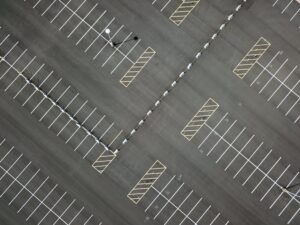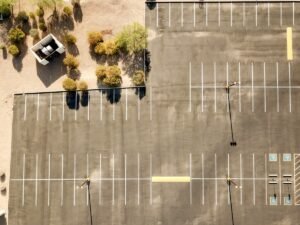
In the case of most commercial buildings, customers and tenants are greeted by the parking lot on the first sight. Worn pavement, cracks of the surface, and oil spots immediately have an impact on the image of the business as being rather professional. What is more important is that overdue asphalt may become an expensive liability.
This is where asphalt sealcoating can be considered to be one of the most worthwhile cost enhancement in the maintenance of property owners and facility managers.
Why do commercial pavements wear out so fast?
The commercial parking lots experience an increase in traffic and crew delivery, a high turnaround movement and also exposure to fuel and hydraulic leakages. Combine unceasing sun exposure, rain, and fluctuation of temperatures and the surface binder in asphalt starts to oxidize.
Widely used damage triggers are:
- Asphalt oils are destroyed by UV radiation.
- Water infiltration into minor surface cracks.
- Oil and fuel lubricating the surface of the pavement.
- Heavy loads on axles resulting in structural fatigue.
Even the slightest wear at the surface level quickly turns into massive failure without security measures in place.
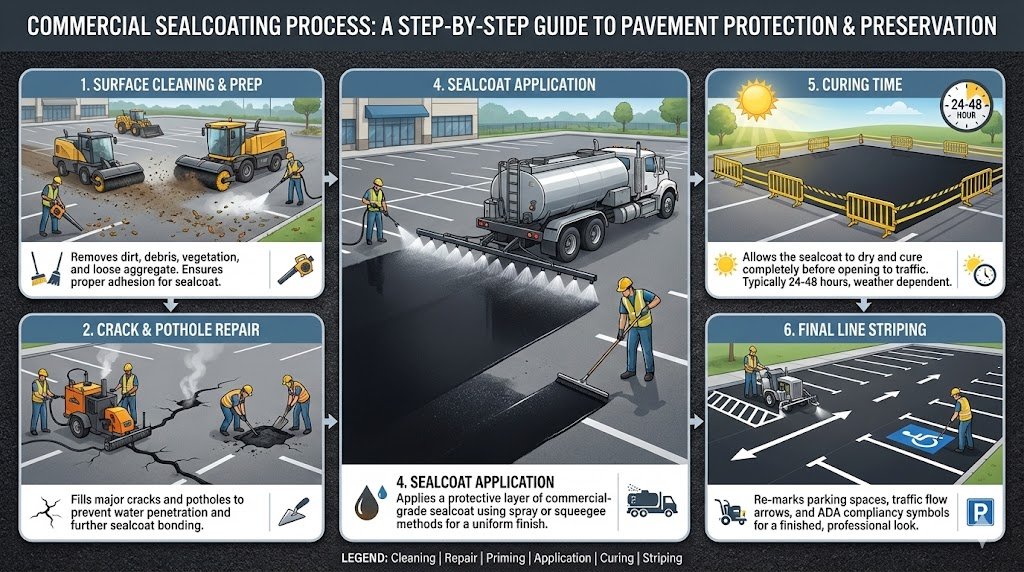
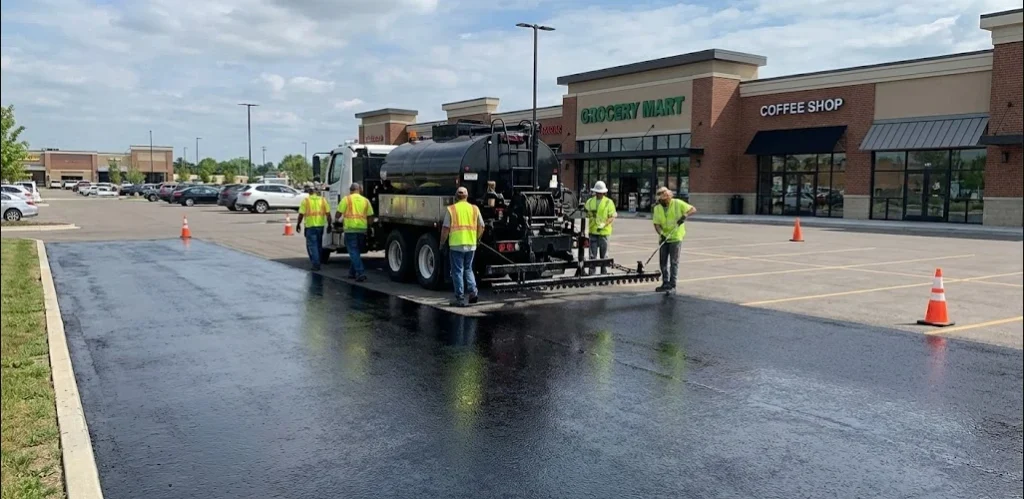
The real sealcoating process.
The problem is that many believe that sealcoating is on the cosmetic level. It is in fact an air tight layer which prevents chemical aging and water permeation.
Knowing that micro-cracks in the pavement widen and result in the pavement being exposed to environmental influences, professional asphalt sealcoating imparts a refined coating layer to seal the micro-cracks, recovering the surface oils and protecting the pavement against environmental exposure. This protection decreases the rate of oxidation that leads to brittleness and surface scaffold by a huge margin.
Important advantages to the owners of commercial property
Increases lifespan of pavements.
Sealcoating does not lead into a significant total asphalt resurfacing or reconstruction due to flexibility of the surface. Using on a regular basis, pavement life is capable of being lengthened by a number of years.
Lowers the maintenance expenses in the long-term.
When untreated, small defects on the surface turn out to be costly to fix. Sealcoating can be used to reduce the rate of growth and wear of the surface, which reduces the rate of patching and structural rehabilitation.
Enhances safety and liability.
Darker closed sections enhance the visibility of striping, cross walkways and directional signs. This is relevant to safer traffic movement of vehicles and people particularly in crowded shopping center and medical buildings.
Improves street appeal and company face.
The appearance of property is enhanced instantly when a new lot is opened. It expresses professionalism, cleanliness and attention to detail to customers, tenants, and the investors.
Barriers against water inversion.
As soon as water comes in via open pores and cracks, bottom layers dilute and freeze-thaw cycles further damage. Sealcoating also retards the values of moisture penalties, which in turn retards the whole structure of pavement.
In the case of most commercial portfolios, asphalt seal coating is an important element of holding asset management.
What is the appropriate time of commercial properties sealcoating?
Timing matters. The first applications should be done after newly laid asphalt is good. Sealcoating is then normally advised after every two to three years, as per the level of traffic and exposure to the environment.
High-traffic properties that have high traffic like:
- Shopping centers
- Office campuses
- Industrial facilities
- Medical buildings and schools.
frequently enjoy increased surface protection programs.
How sealcoating compares to doing nothing
| Maintenance Approach | Short-Term Cost | Long-Term Impact | Overall Risk |
| No surface protection | Low | Rapid surface deterioration | High repair liability |
| Crack sealing only | Medium | Slows localized damage | Moderate |
| Sealcoating + crack sealing | Medium | Preserves full surface layer | Low |
| Full resurfacing | Very high | Restores structure after failure | Business disruption |
Preventive programs centered around asphalt sealcoating consistently outperform reactive repair strategies in long-term financial planning.
Striping and layout post-sealing
The purpose of striping and layout is to lessen the risk of concentration at a specific point, preventing overloading and thus avoiding operation overload.Role of striping and layout following sealing Striping and layout serves to reduce the risk of concentration at a single location and thereby reduce over loading and avoid overload of operation.
When the new surface has cured the professional line striping comes back in:
- Parking stalls
- ADA-accessible spaces
- Fire lanes
- Directional arrows
- Loading zones
Clear markings enhance movements, lessen patient congestions, and facilitate their accessibility and safety standards.
Such a combined strategy makes surface protection a functional addition, rather than an aesthetic one.
The contents of a professional sealcoating process.
An adequate commercial use usually entails:
- Comprehensive cleaning of the surface and removal of the debris.
- Stain sealing and oil spot priming.
- Minor surface repair and crack filling.
- Squeegee or spray controlled application.
- Adequate time to cure and re-open traffic.
Application of quality is important. Coating lumps or accelerated curing may cause decreased performance and decreased coating life.
That is why, more experienced contractors arrange asphalt sealcoating when there is good weather and the traffic is low.
Misconceptions property owners make.
Most owners postpone sealcoating due to the fact that the pavement still looks fine. Regrettably, discernible damage is typically manifested when surface depreciation has already begun.
There is also a notion that sealcoating creates structural fixations. It does not supersede full-depth repairs. It preserves sound pavement as well as slows the aging of surfaces and is, therefore, suitable in well-maintained lots.
Operational and environmental issues.
New sealers will be needed to comply with the environmental requirements and minimize dangerous run-off. A number of commercial operators are currently chartered towards low-odor and low-VOC formulations in the interests of ensuring minimal disturbance of tenants and visitors.
Sealcoating planning in off-peak times or at night can be used to avoid loss of revenue and inconvenience of customer.
The relevance of sealcoating to commercial asset management strategies.
The increased use of predictive maintenance models is increasing in facility managers.
Sealcoating is crucial to the extent that it:
- Budgets the maintenance yearly.
- Reduces emergency repairs
- Hoards capital improvement funds.
- Increases property value on the long run.
Operationally, asphalt sealcoating is a source of tangible performance and financial gain.
Final Thought
Parking lots occupied by businesses are costly resources which should be taken good care of. The Sealcoating is not merely an aesthetics process, but is rather an investment into strategy of maintenance, which protects the structure of the pavement, helps to decrease the number of repair processes (in the long-term), enhances the safety and enhances the presentation of the property. Once used regularly and in a professional manner, it will turn out to be one of the most economical investments the owners of the commercial property can make.